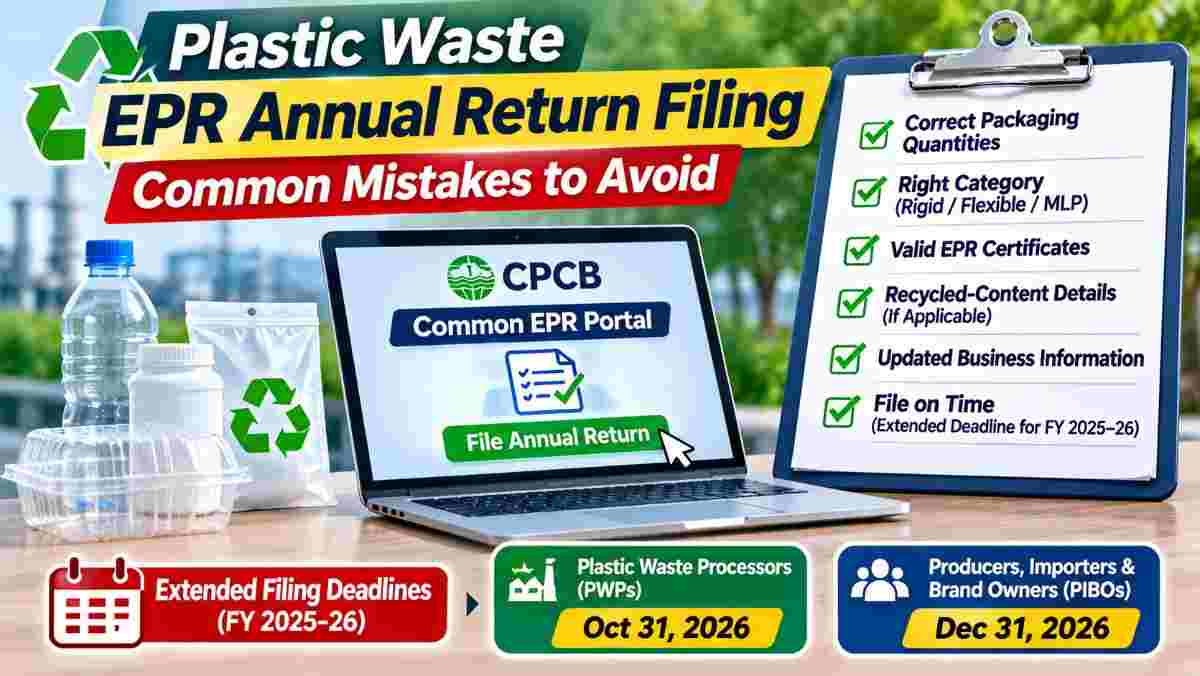
A business may complete its Extended Producer Responsibility (EPR) registration, arrange plastic waste recycling, and purchase the required certificates, yet still face compliance difficulties when filing its annual return.
The problem often comes from inaccurate packaging data, incorrect waste categorization, mismatched EPR certificates, or missing supporting records.
Under India's Plastic Waste Management Rules, obligated businesses must account for the plastic packaging they introduce into the market and demonstrate how their applicable EPR obligations have been fulfilled.
For producers, importers, and brand owners, EPR annual return filing is an important part of this reporting process.
Errors in annual returns can create discrepancies in the CPCB portal, delay compliance verification, and potentially result in regulatory action.
This guide explains the most common EPR filing mistakes, how businesses can prevent them, and what information should be checked before submitting an annual return.
EPR annual return filing is the process through which obligated businesses report their plastic packaging activities and compliance with Extended Producer Responsibility requirements.
Under the EPR framework, businesses must account for applicable plastic packaging quantities and demonstrate fulfillment of their recycling, reuse, recycled-content, or end-of-life management obligations.
The Central Pollution Control Board (CPCB) administers a centralized reporting system to support registration, tracking, and verification.
Depending on the business category, annual return information may include:
Plastic packaging introduced into the market
Packaging quantities by material category
Applicable EPR targets
Details of plastic waste recycling
EPR certificates acquired or transferred
Recycled plastic content information
Reuse-related data, where applicable
Permitted end-of-life disposal information
Supporting compliance documentation
Accurate reporting helps businesses demonstrate that their plastic waste management activities match their regulatory obligations.
EPR annual return requirements apply to businesses covered under India's plastic packaging EPR framework.
The principal obligated entities include producers, importers, brand owners, and registered plastic waste processors.
A producer generally includes an entity involved in manufacturing plastic packaging or covered plastic packaging products under the applicable rules.
Such businesses may have obligations relating to registration, category-wise plastic packaging data, recycling targets, and annual reporting.
Yes. Importers covered by the regulations must account for relevant imported plastic packaging and packaging associated with imported products.
Importers should maintain accurate customs, purchase, and product packaging records to support their declarations.
Brand owners covered by EPR requirements must report relevant plastic packaging quantities and demonstrate fulfillment of their applicable obligations.
Certain exemptions and special provisions may apply depending on the entity's classification and the current regulations.
Businesses should verify their regulatory category before determining their reporting responsibilities.
Yes. Registered Plastic Waste Processors (PWPs), including eligible recyclers and other processors, have their own reporting obligations.
Their annual returns generally involve category-wise quantities of plastic waste processed and other information required under the applicable framework.
Because processor reporting differs from producer, importer, and brand-owner reporting, companies should not use the same checklist without checking their specific obligations.
The ordinary statutory deadline for producers, importers, and brand owners is generally June 30 of the following financial year.
However, deadlines may be extended through government or CPCB notifications.
For FY 2025–26, the Ministry of Environment, Forest and Climate Change announced special extensions due to difficulties associated with the EPR reporting system.
The reported revised deadlines are:
Plastic Waste Processors: October 31, 2026
Producers, Importers, and Brand Owners: December 31, 2026
The previous standalone plastic packaging EPR portal was discontinued on June 28, 2026, and existing data was migrated to the Common EPR Portal.
Businesses should use the CPCB Common EPR Portal and confirm the latest official filing instructions before submission.
The filing deadline is important, but preparing accurate data throughout the financial year is equally essential.
Most EPR reporting errors arise from inaccurate quantities, incomplete documentation, incorrect category selection, or inconsistencies between business records and portal information.
Understanding these mistakes can help companies identify potential problems before submission.
One of the most common filing mistakes is entering inaccurate plastic packaging quantities.
This may happen when businesses rely only on sales figures without properly calculating the weight of plastic packaging associated with their products.
For example, a business selling packaged goods may record the number of products sold but fail to determine the total weight of plastic packaging introduced into the market.
Other common problems include:
Using outdated packaging weights
Missing imported packaging quantities
Incorrectly converting kilograms into metric tonnes
Failing to account for applicable packaging categories
Double-counting certain packaging transactions
Overlooking relevant pre-consumer plastic packaging waste
How can businesses avoid this mistake?
Maintain a packaging inventory that records the type, quantity, and weight of plastic packaging associated with each product.
Reconcile packaging data with purchase records, import documents, production reports, and sales information.
Where estimates are used, maintain a clear and supportable calculation method.
Plastic packaging must be classified according to the categories specified under the applicable EPR rules.
The framework includes categories covering rigid plastic packaging, flexible plastic packaging, multilayered packaging containing plastic and another material, and certain compostable plastic packaging.
Incorrect categorization can affect the calculation and fulfillment of EPR obligations.
For example, a multilayered package containing plastic and another non-plastic material should not automatically be reported as ordinary rigid plastic packaging.
How can businesses avoid this mistake?
Review packaging material specifications and identify the correct category before entering quantities into the portal.
Businesses using multiple types of packaging should maintain separate records for each applicable category.
When the composition of a packaging material is unclear, obtain the relevant technical information from the packaging supplier.
EPR certificates help demonstrate fulfillment of applicable plastic waste processing obligations.
However, businesses should not assume that every certificate offered by a third party is automatically acceptable.
Certificates must meet the requirements of the applicable regulatory framework and be associated with eligible registered processors or permitted transactions.
Potential errors include:
Using certificates from ineligible sources
Selecting the wrong packaging category
Reporting incorrect quantities
Failing to reconcile transferred certificates
Using certificates that do not appear correctly in portal records
Assuming that a payment receipt is equivalent to a valid EPR certificate
How can businesses avoid this mistake?
Verify the processor's registration and confirm the relevant certificate details through the applicable CPCB portal.
Compare certificate quantities and categories with the company's outstanding EPR obligations.
Businesses should also maintain invoices, transaction references, and supporting processor documentation.
A business may purchase or receive EPR certificates but still report figures that do not match its actual obligations.
For instance, the quantity recorded in internal spreadsheets may differ from the quantity transferred or recognized in the portal.
Such discrepancies can affect compliance reconciliation.
The regulatory framework provides for cross-checking reported information between obligated entities and registered waste processors.
How can businesses prevent certificate mismatches?
Perform a reconciliation before filing:
Compare category-wise EPR targets with reported quantities.
Verify eligible certificates available in the portal.
Check whether certificate transfers are completed.
Review any outstanding compliance balance.
Investigate differences between internal records and portal data.
A documented reconciliation process can significantly reduce preventable reporting errors.
EPR compliance does not involve only purchasing recycling certificates.
Applicable regulations may also require obligated entities to use specified levels of recycled plastic content in packaging, subject to material categories, exemptions, and current requirements.
Businesses may make reporting mistakes if they fail to distinguish between packaging waste recycled through EPR arrangements and recycled material used in manufacturing new packaging.
These are different compliance considerations.
How can businesses avoid this mistake?
Maintain separate records for the recycled-content information and the certificates used to demonstrate applicable EPR fulfillment.
Where recycled material is purchased, retain supplier records and relevant supporting documentation.
The exact obligations should be checked against the applicable rules for the relevant financial year.
Another common mistake is failing to update the information associated with the registered business.
Changes in company details, operational activities, authorized representatives, or relevant business records may create inconsistencies during reporting.
For example, the details shown on supporting records may not match the information stored in the EPR registration profile.
How can businesses prevent these errors?
Before filing, review the registered entity details, relevant business identifiers, authorized user information, and any applicable registration updates.
Businesses should also check the information migrated to the Common EPR Portal and report discrepancies using the available official process.
Preparing an annual return at the last moment can make it difficult to identify missing documents or reconcile transactions.
This risk is particularly significant for companies handling multiple packaging categories, suppliers, or recycling partners.
Late preparation may reveal issues such as missing quantity calculations, pending certificate transfers, or inconsistent purchase records.
How can businesses avoid deadline-related mistakes?
Compile packaging and waste management data throughout the financial year.
Assign responsibility for maintaining EPR records and conduct periodic internal reviews.
Early preparation allows time to correct inconsistencies before the filing deadline.
Businesses should maintain documentation that supports the quantities and transactions reported in their annual returns.
The exact information required depends on the type of obligated entity, packaging categories, and applicable portal instructions.
A practical document checklist includes:
EPR registration certificate and business details
Plastic packaging quantity records
Product-wise packaging weight calculations
Packaging purchase and sales records
Import documentation, where applicable
Category-wise EPR target calculations
Records of registered waste processors
EPR certificate transaction details
Recycled-content procurement records, where applicable
Relevant reuse and end-of-life disposal records
Previous annual return information
Supporting invoices and compliance documentation
Not every document will necessarily be uploaded during filing. However, maintaining organized records can help with verification, audits, and future reporting.
Before submitting an EPR annual return, businesses should carry out an internal review of the information that will appear in the portal.
Step 1: Confirm registration details.
Check the business registration, applicable entity category, and relevant portal information.
Step 2: Verify plastic packaging quantities.
Reconcile packaging data with supporting production, sales, purchasing, or import records.
Step 3: Review packaging classifications.
Confirm that every reported packaging quantity is assigned to the correct regulatory category.
Step 4: Calculate applicable EPR obligations.
Review the targets generated or calculated under the relevant rules and financial year.
Step 5: Verify EPR certificates.
Check certificate eligibility, categories, transactions, and quantities recognized in the portal.
Step 6: Review recycled-content and other obligations.
Confirm whether separate reporting requirements apply to recycled content, reuse, or permitted end-of-life disposal.
Step 7: Complete a final reconciliation.
Investigate discrepancies between internal records and portal information before submitting the return.
Step 8: Retain submission evidence.
Save the acknowledgment, submitted return, relevant records, and transaction references.
This process gives compliance teams a structured way to prepare accurate information and reduce repeated corrections.
Incorrect or incomplete EPR reporting can create compliance difficulties, particularly if the reported quantities do not match supporting records or recognized EPR certificates.
Depending on the circumstances and applicable regulations, authorities may seek clarification, require correction, conduct verification, or initiate enforcement proceedings.
Environmental Compensation may also apply to specified failures to meet EPR obligations.
Businesses should not assume that submitting an annual return automatically demonstrates full compliance.
The information must accurately reflect the entity's obligations and relevant supporting transactions.
If a material error is discovered, the business should review the available correction procedure and seek clarification through the appropriate regulatory channel where necessary.
Businesses in Gujarat can improve EPR compliance by maintaining accurate packaging data, reviewing regulatory changes, and creating a consistent reporting process.
This is especially relevant for manufacturers, importers, and brand owners handling multiple types of plastic packaging.
A practical compliance approach includes:
Reviewing applicable EPR registration requirements
Maintaining category-wise packaging records
Tracking changes in packaging suppliers and materials
Verifying plastic waste processor registration
Reconciling EPR certificates regularly
Monitoring filing deadlines and regulatory updates
Retaining supporting records for verification
Companies should also review how environmental compliance responsibilities are assigned internally.
Where several departments contribute information, procurement, production, finance, and environmental compliance teams should use consistent records.
Environ Pvt. Ltd. provides environmental consultancy services for businesses seeking assistance with regulatory requirements and environmental compliance.
Producers, importers, brand owners, and registered plastic waste processors covered under the applicable Plastic Waste Management Rules have reporting obligations. Specific requirements depend on the entity's classification.
For FY 2025–26, special extensions reportedly set October 31, 2026, for plastic waste processors and December 31, 2026, for producers, importers, and brand owners. Businesses should verify the latest CPCB notifications before relying on a deadline.
The answer depends on the entity's applicable obligations, available fulfillment mechanisms, and reporting position. Businesses should not claim an EPR obligation has been fulfilled unless sufficient recognized evidence supports that claim.
Incorrect quantities may affect the calculation of EPR obligations and create discrepancies during portal reconciliation or regulatory verification. Businesses should investigate and correct errors through the applicable process.
No. EPR registration establishes the entity's registration under the applicable framework, while annual return filing reports relevant activities and compliance information for a financial year.
Covered entities should use the CPCB Common EPR Portal, which replaced the previous standalone plastic packaging EPR portal in June 2026.
Plastic waste EPR compliance requires accurate records, a clear understanding of regulatory categories, and proper verification of waste processing documentation.
For businesses handling multiple packaging materials or operating across locations, preparing an accurate annual return can involve coordination between several departments and external stakeholders.
Environ Pvt. Ltd., based in Ahmedabad, Gujarat, provides environmental consultancy and regulatory compliance support for industrial and commercial organizations.
Businesses seeking assistance with environmental obligations can review their reporting requirements, supporting documentation, and compliance procedures before the applicable filing deadline.
Need Assistance With Environmental Compliance?
Contact Environ Pvt. Ltd. to discuss your environmental regulatory requirements and confirm the availability of assistance for plastic waste EPR documentation and compliance.
Preparing reliable records throughout the financial year can help businesses reduce reporting errors and maintain greater confidence in their environmental compliance processes.

A factory chimney may appear to be operating normally, but the gases released through it can contain pollutants that are not visible to the human eye. Boilers, furnaces, diesel generator sets, and industrial manufacturing processes can release particulate matter and gaseous pollutants into the atmosphere.

Your Effluent Treatment Plant (ETP) may be running every day, with pumps operating, blowers functioning, and wastewater passing through each treatment stage.
For factory owners and environmental managers in Gujarat, keeping pollution control permissions valid is essential for uninterrupted industrial operations. Missing a compliance deadline, maintaining incomplete monitoring records, or failing to update approval details can create regulatory difficulties.
Confused about CTE and CTO from the Gujarat Pollution Control Board? Here is what each approval covers, when you need it, and how the two differ.