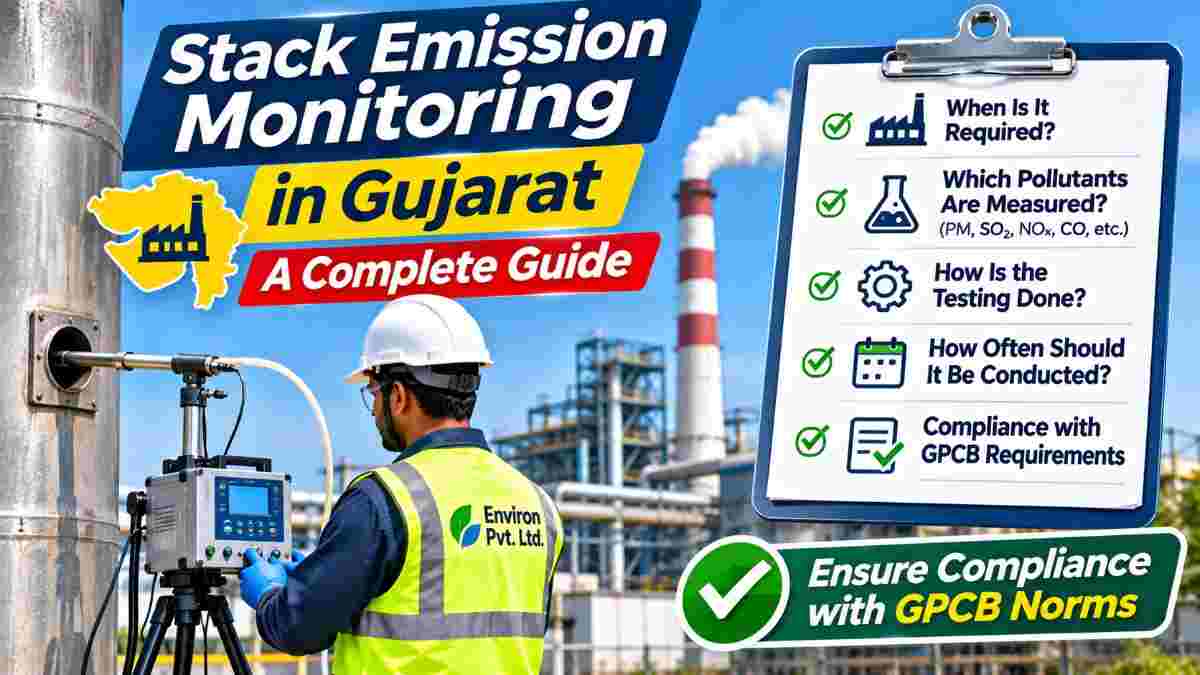
A factory chimney may appear to be operating normally, but the gases released through it can contain pollutants that are not visible to the human eye. Boilers, furnaces, diesel generator sets, and industrial manufacturing processes can release particulate matter and gaseous pollutants into the atmosphere.
For industries operating in Gujarat, measuring these emissions is an important part of environmental compliance.
Stack emission monitoring in Gujarat helps businesses determine whether pollutants released through their industrial chimneys remain within the limits specified by the Gujarat Pollution Control Board (GPCB) and applicable environmental regulations.
However, many factory owners and environmental managers have practical questions: Is stack testing mandatory? Which pollutants need to be measured? How often should testing be conducted? What happens if the results exceed the permitted limits?
This guide explains how stack emission monitoring works, when it is required, and what industrial facilities should prepare before scheduling a test.
Stack emission monitoring is the process of collecting and analyzing air pollutants released through an industrial chimney, exhaust stack, or process vent.
The purpose is to measure pollutant concentrations and compare the results with applicable emission standards.
Unlike ambient air quality monitoring, which measures pollutants in the surrounding environment, stack monitoring measures emissions directly at their source.
Industrial emission testing may involve collecting gas samples, measuring particulate matter, and recording operating conditions such as gas temperature, velocity, and flow rate.
The results help industries understand whether their pollution control equipment is functioning effectively and whether their emissions meet regulatory requirements.
For businesses operating boilers, furnaces, DG sets, or other combustion equipment, stack emission monitoring services can support routine environmental testing and compliance reporting.
Stack emission monitoring is required when an industrial facility's consent conditions or applicable environmental regulations prescribe emission testing.
Industries operating under the GPCB consent framework must comply with the pollution control conditions specified in their Consent to Operate or Consolidated Consent and Authorization (CCA).
For many industrial units with combustion equipment or process stacks, these conditions include periodic emission testing.
Stack emission monitoring is relevant to a wide range of industrial operations, including:
Chemical and pharmaceutical manufacturing
Textile processing and dyeing
Engineering and metal processing
Foundries and manufacturing units
Food processing facilities with boilers
Ceramic and glass manufacturing
Cement and mineral processing
Power generation facilities
Industrial operations using DG sets
Facilities operating furnaces, heaters, or incinerators
The specific monitoring requirements depend on the facility's equipment, fuel type, production processes, and applicable emission standards.
Not every industry is required to monitor the same pollutants or follow the same testing schedule.
Stack emission testing may form part of the environmental monitoring requirements associated with a GPCB Consent to Operate.
The consent order typically identifies the applicable emission sources, permitted limits, and any monitoring or reporting requirements.
Industries should review their existing consent conditions to determine which stacks require testing.
Businesses can also review Environ's Consent to Operate services for assistance with regulatory approval and compliance requirements.
The pollutants measured during stack emission testing depend on the fuel being burned, the manufacturing process, and the applicable environmental standards.
Some industrial stacks require testing for only a few parameters, while others may require additional pollutant analysis.
Particulate matter refers to solid particles and liquid droplets suspended in exhaust gases.
These particles may originate from combustion, material handling, manufacturing operations, or industrial processes.
High particulate emissions can indicate problems with dust collection systems, combustion conditions, or pollution control equipment.
Common equipment used to reduce particulate emissions includes bag filters, cyclones, and electrostatic precipitators.
Sulfur dioxide can be produced when fuels or materials containing sulfur are burned or processed.
The quantity released depends on factors such as fuel sulfur content, combustion conditions, and the effectiveness of pollution control systems.
SO? monitoring helps determine whether the facility meets the applicable emission limits.
Nitrogen oxides are commonly formed during high-temperature combustion.
Boilers, furnaces, engines, and other combustion equipment may release NOx depending on operating temperature, fuel characteristics, and combustion conditions.
Monitoring helps identify whether NOx emissions remain within the prescribed limits.
Yes. Depending on the industrial source and applicable requirements, stack testing may include:
Carbon monoxide (CO)
Hydrogen chloride (HCl)
Hydrogen fluoride (HF)
Ammonia (NH?)
Chlorine (Cl?)
Volatile Organic Compounds (VOCs)
Other process-specific pollutants
Stack temperature, velocity, moisture, oxygen concentration, and flow may also need to be measured to calculate or normalize emission results.
For facilities releasing pollutants from manufacturing processes rather than fuel combustion alone, process stack emission monitoring may be relevant.
Stack emission monitoring involves selecting suitable sampling locations, collecting representative samples, analyzing the pollutants, and comparing the results with applicable limits.
The process should follow relevant CPCB methods, recognized testing procedures, and the conditions specified for the facility.
The monitoring team first identifies the industrial stacks that require testing.
These may include boiler chimneys, furnace exhausts, DG set stacks, and manufacturing process vents.
The team reviews the stack dimensions, sampling access, operating conditions, and required test parameters.
Sampling ports provide access for inserting testing equipment into the stack.
The monitoring team checks whether the ports are suitably positioned and accessible for the prescribed sampling method.
Appropriate platforms, access arrangements, and safety precautions are essential because industrial stacks may be elevated and contain hot exhaust gases.
For particulate matter testing, isokinetic sampling is commonly used where required by the applicable method.
Isokinetic sampling involves drawing the gas sample at a velocity matched to the local stack gas velocity.
This helps obtain a representative particulate sample.
Gaseous pollutants may require separate sampling or analytical methods according to the substance being measured.
Collected samples are analyzed using the prescribed testing methods.
The laboratory determines the concentrations of the relevant pollutants and processes the field measurements.
Quality control and equipment calibration are important for obtaining reliable results.
The final report generally includes:
Stack identification and source details
Sampling date and operating conditions
Parameters analyzed
Sampling and analytical methods
Measured pollutant concentrations
Relevant gas flow and temperature information
Applicable emission limits
Results and observations
The report can then be used for internal compliance reviews and submission to the relevant authority where required.
There is no single monitoring frequency that applies to every industrial facility in Gujarat.
The required frequency depends on the industry category, equipment, applicable regulations, and the conditions specified by GPCB.
Some facilities may need periodic manual testing, while others may be required to operate continuous emission monitoring equipment.
Monthly or quarterly testing may be prescribed for particular facilities, but neither schedule should be treated as a universal requirement.
Industries must check the monitoring frequency specified in their consent conditions and any applicable regulatory directions.
A Continuous Emission Monitoring System (CEMS) measures designated stack parameters continuously or at frequent intervals.
These systems may monitor pollutants such as particulate matter, SO?, NOx, or other parameters according to the industry's regulatory requirements.
CEMS can provide ongoing information about emission trends and help identify abnormal operating conditions.
Where continuous monitoring is mandatory, the facility must follow the applicable requirements for installation, calibration, operation, maintenance, and data transmission.
Periodic manual testing may still be necessary for verification or other specified purposes.
Stack emission monitoring and ambient air quality monitoring both evaluate air pollution, but they serve different purposes.
Stack emission monitoring measures pollutants directly from industrial exhaust sources, such as chimneys, boilers, and process stacks.
Ambient air quality monitoring measures pollutant concentrations in the surrounding outdoor air.
For example, stack testing can help determine whether a boiler is releasing particulate matter above its permitted limit.
Ambient monitoring can help evaluate the air quality around the industrial premises or surrounding locations.
An industry may be required to conduct both types of monitoring depending on its consent conditions.
If stack emission results exceed the applicable limits, the facility should investigate the cause and implement suitable corrective measures.
High emissions may indicate problems with combustion conditions, pollution control equipment, maintenance, or changes in manufacturing operations.
A failed monitoring result should not be ignored or treated as an isolated event without investigation.
Common causes include:
Damaged or leaking bag filters
Poor dust collector maintenance
Electrostatic precipitator malfunction
Inadequate air pollution control capacity
Changes in raw materials or fuel
Excessive process loading
Improper equipment operation
The actual cause should be identified through equipment inspection and operating data.
Corrective measures may include:
Repairing damaged pollution control equipment
Reviewing combustion conditions
Improving preventive maintenance
Replacing ineffective filter components
Optimizing equipment operation
Checking control-system design capacity
Evaluating process or fuel changes
The appropriate solution depends on the source and pollutants involved.
Facilities experiencing repeated exceedances may need an engineering assessment rather than temporary operational adjustments.
Environ provides air pollution control system design services for industrial facilities requiring appropriate pollution control solutions.
Where a result exceeds a regulatory limit, industries must also follow their applicable consent conditions and reporting obligations.
Preparing the site before monitoring helps technicians conduct testing safely and obtain representative results.
A practical preparation checklist includes:
Identify all stacks requiring monitoring.
Review the applicable consent conditions.
Confirm the required pollutants and test methods.
Provide suitable sampling ports and safe access.
Ensure normal, representative operating conditions.
Make equipment operating details available.
Maintain pollution control system records.
Arrange site safety permissions and supervision.
Keep previous stack monitoring reports available.
Confirm the required report format and submission schedule.
The monitoring agency should be informed of any unusual operating conditions that may affect the sampling results.
Industries should also avoid making unrepresentative temporary operational changes solely to obtain favorable test readings.
NABL accreditation provides independent recognition of a laboratory's technical competence for activities included within its accredited scope.
For industrial environmental monitoring, selecting a suitably qualified laboratory helps improve confidence in sampling, analysis, reporting, and quality control.
However, accreditation should not be considered a blanket approval for every possible test.
Industries should verify that the laboratory's current accreditation scope covers the specific monitoring parameters and methods required for the project.
Any separate recognition or approval required by GPCB or CPCB should also be confirmed.
Environ Pvt. Ltd. operates an in-house NABL-accredited environmental laboratory in Ahmedabad, supporting environmental testing and monitoring services for industrial clients.
Stack emission monitoring is mandatory where required under applicable environmental regulations or the facility's GPCB consent conditions. The relevant sources, parameters, and testing frequency depend on the industrial operation.
Boiler stack monitoring generally focuses on pollutants associated with fuel combustion. Process stack monitoring may involve pollutants released from manufacturing reactions or industrial processes. The required testing parameters and methods can differ.
The cost depends on the number of stacks, pollutants tested, sampling requirements, site accessibility, and applicable laboratory methods. Industries should request a quotation based on their specific monitoring requirements.
Proper sampling access is necessary for reliable testing. If suitable sampling ports are unavailable, the facility should consult a qualified monitoring professional about the arrangements needed to meet applicable sampling requirements.
Stack monitoring may be required for DG sets depending on their capacity, applicable emission standards, installation requirements, and consent conditions. Businesses should verify the requirements relevant to their equipment.
The industry should review the sampling results, identify the source of the exceedance, inspect relevant equipment, and implement corrective measures. Any required regulatory reporting or follow-up testing should be completed in accordance with the applicable conditions.
Industrial air emission testing requires appropriate sampling equipment, trained personnel, reliable laboratory analysis, and knowledge of the relevant environmental standards.
Environ Pvt. Ltd., headquartered in Ahmedabad, Gujarat, provides environmental consultancy and laboratory testing services for industrial facilities.
Its stack emission monitoring services cover boilers, furnaces, diesel generator sets, and other relevant industrial emission sources.
The company combines environmental testing with regulatory compliance support and air pollution control engineering, helping industries investigate monitoring results and assess suitable corrective actions.
Need Stack Emission Monitoring for Your Industrial Facility?
Contact Environ Pvt. Ltd. to discuss stack emission testing, monitoring requirements, and industrial air pollution compliance.
Share your stack details, fuel type, required testing parameters, and monitoring schedule to request a suitable testing plan and quotation.
A business may complete its Extended Producer Responsibility (EPR) registration, arrange plastic waste recycling, and purchase the required certificates, yet still face compliance difficulties when filing its annual return.

Your Effluent Treatment Plant (ETP) may be running every day, with pumps operating, blowers functioning, and wastewater passing through each treatment stage.

For factory owners and environmental managers in Gujarat, keeping pollution control permissions valid is essential for uninterrupted industrial operations. Missing a compliance deadline, maintaining incomplete monitoring records, or failing to update approval details can create regulatory difficulties.
Confused about CTE and CTO from the Gujarat Pollution Control Board? Here is what each approval covers, when you need it, and how the two differ.