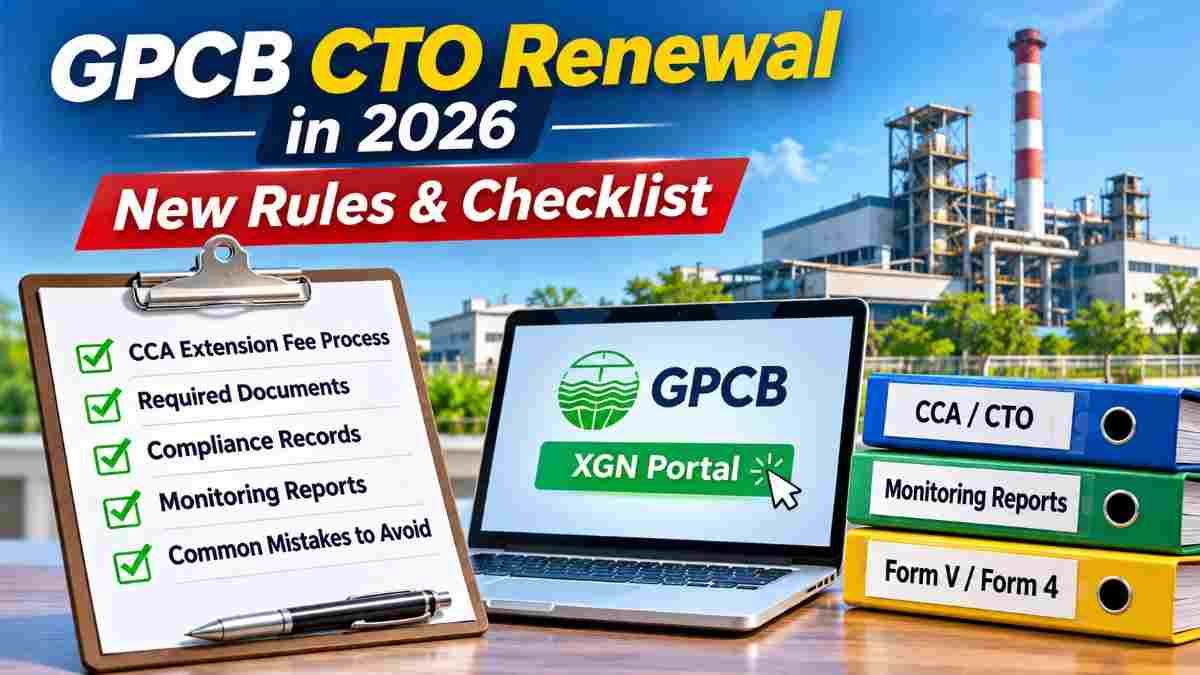
For factory owners and environmental managers in Gujarat, keeping pollution control permissions valid is essential for uninterrupted industrial operations. Missing a compliance deadline, maintaining incomplete monitoring records, or failing to update approval details can create regulatory difficulties.
If your company is preparing for GPCB CTO renewal, there is an important change to understand.
On July 31, 2026, the Gujarat Pollution Control Board introduced a Consolidated Consent and Authorization (CCA) Extension Fee system, replacing the earlier routine CCA renewal process for eligible industrial units.
However, this change does not eliminate the responsibility to comply with environmental laws, maintain pollution control equipment, or retain supporting documentation.
This guide explains the updated process, the compliance records industries should keep ready, and the common mistakes to avoid.
Consent to Operate (CTO) is a regulatory approval required for industries covered by applicable pollution control legislation.
In Gujarat, the Gujarat Pollution Control Board generally administers these approvals through the Consolidated Consent and Authorization (CCA) framework.
CCA brings together relevant permissions under the Water (Prevention and Control of Pollution) Act, 1974, the Air (Prevention and Control of Pollution) Act, 1981, and applicable hazardous waste authorization requirements.
A CCA order establishes conditions relating to industrial operations, including:
Permitted manufacturing activities and production capacities
Water consumption and wastewater generation
Effluent treatment and disposal arrangements
Air emissions and pollution control equipment
Hazardous waste generation, storage, and disposal
Environmental monitoring and reporting
Industries must comply with the conditions applicable to their individual consent orders.
For businesses establishing new operations, the Consent to Operate (CCA/CTO) services offered by Environ provide technical assistance with regulatory approvals and related documentation.
GPCB introduced a new CCA Extension Fee mechanism through its office order dated July 31, 2026.
Under the updated framework, eligible industries holding an existing CCA are required to use the extension fee process rather than follow the previous routine renewal application procedure.
The change is intended to simplify periodic approval administration while continuing environmental regulatory oversight.
The extension fee system allows eligible existing industrial units to maintain the applicable consent period through a prescribed online fee and verification process.
Under the reported framework, industries must:
Identify the applicable extension fee cycle.
Review their current CCA details and compliance status.
Submit the required extension request through the GPCB XGN portal.
Pay the prescribed extension fee within the applicable due date.
Obtain the extension fee payment acknowledgment after verification.
The acknowledgment records the fee cycle and the next applicable payment date.
Businesses should confirm their eligibility and current instructions through the official GPCB portal rather than assume that every industrial unit follows an identical procedure.
No. The extension fee mechanism changes how the continuation of an existing consent is administered, but it does not remove obligations under applicable environmental laws or consent conditions.
Industries must continue operating their pollution control equipment, conducting required monitoring, managing hazardous waste, and submitting applicable statutory reports.
Noncompliance may still result in regulatory action.
Under the 2026 system, the documents required for the extension transaction may differ from the historical CCA renewal checklist.
The following records are recommended for compliance readiness. They should not be interpreted as a mandatory upload list for every extension fee request.
Industries should maintain copies of their existing approval and related documents, including:
Current CCA order
Previous CCA orders, where relevant
CTE approval and amendments
GPCB identification and application references
Applicable consent conditions
Records of changes approved by the Board
These documents help identify permitted manufacturing activities and environmental limits.
They are also useful when determining whether an operational change requires a separate amendment.
Industrial units should maintain environmental monitoring reports according to their consent conditions and applicable rules.
Depending on the operation, these may include:
Stack emission monitoring reports
Ambient air quality monitoring reports
Treated effluent analysis reports
Wastewater testing records
Noise monitoring results
Groundwater or other water analysis reports, where applicable
Monitoring reports should be current for the relevant reporting period and prepared by appropriately recognized or accredited laboratories where required.
For testing support, Environ provides environmental compliance services alongside laboratory monitoring and analysis.
Industries generating hazardous waste should maintain records required under the Hazardous and Other Wastes (Management and Transboundary Movement) Rules, 2016, and their applicable authorization.
Relevant documentation may include:
Hazardous waste authorization details
Waste generation and storage records
Waste disposal manifests
Authorized recycler or disposal facility records
Annual returns in Form 4, where applicable
Records of common disposal facility membership
Actual waste generation and disposal practices should match the approved arrangements.
Environmental reporting obligations vary according to the facility, its industry category, and applicable conditions.
Industries should check whether they must maintain or submit:
Environmental Statement in Form V
Environmental audit reports
Compliance reports for audit recommendations
Environmental Clearance compliance reports, where applicable
Records of corrective actions taken
The earlier GPCB CCA renewal checklist specifically included previous consent compliance, Form V, applicable hazardous waste Form 4 returns, and other conditional documentation.
That historical checklist remains useful as a reference for recordkeeping, but should not be represented as the current universal extension fee submission checklist.
Industrial facilities should maintain operational records for installed pollution control systems.
These may include:
Effluent Treatment Plant operating logs
Sewage Treatment Plant maintenance records
Air pollution control system maintenance reports
Sludge handling records
Equipment calibration records
Online monitoring data, where applicable
Corrective maintenance documentation
Maintaining these records can help demonstrate that pollution control systems are operating consistently.
For facilities experiencing repeated treatment issues, technical assessment may be necessary before the problem affects environmental compliance.
Eligible industries should follow the current instructions available through the GPCB online system.
A practical preparation process includes the following steps.
Check the current consent order, applicable conditions, facility details, and compliance status.
Confirm that the approval reflects the actual industrial operations.
Determine whether the facility qualifies for the CCA Extension Fee mechanism.
Eligibility and fee requirements should be checked against the latest GPCB instructions applicable to the industrial unit.
Review the facility information recorded in the GPCB XGN system.
Check for outdated information or differences between the online records and actual site operations.
Follow the portal workflow for the relevant extension cycle and complete the prescribed payment.
Keep the transaction reference and related records.
After the applicable verification, retain the extension fee acknowledgment and record the next payment date.
The acknowledgment should be maintained with the company's environmental compliance documents.
An extension fee and a CCA amendment serve different purposes.
The extension mechanism relates to continuation of an existing consent under the applicable conditions.
An amendment may be necessary when the industrial unit changes important details covered by its approval.
Potential changes requiring regulatory review include:
Increasing production capacity
Adding new products or manufacturing processes
Changing fuel types
Increasing wastewater generation
Modifying effluent disposal arrangements
Adding emission sources
Changing hazardous waste streams
Expanding the approved facility
Not every operational adjustment automatically requires an amendment. The applicable rules and existing consent conditions determine the approval requirements.
Industries should obtain regulatory clarification before implementing significant changes.
Even where the administrative renewal process has been simplified, industrial units can face problems when compliance records are incomplete or outdated.
Common mistakes include:
Missing the applicable extension fee due date
Assuming the extension eliminates environmental monitoring obligations
Failing to review current consent conditions
Operating beyond approved production capacity
Maintaining outdated hazardous waste records
Ignoring repeated ETP or emission monitoring failures
Making operational changes without checking amendment requirements
Failing to retain the payment acknowledgment
A periodic internal compliance review can help identify such issues before they result in regulatory difficulties.
GPCB introduced a CCA Extension Fee system on July 31, 2026, replacing the previous routine CCA renewal process for eligible industrial units. Businesses should verify their specific eligibility and current portal requirements.
The exact documents required for an extension transaction depend on the applicable instructions. Industries should maintain their current consent, monitoring reports, statutory returns, and relevant compliance records even where those documents are not required to be uploaded with the fee request.
Payment must be completed according to the applicable procedure, and the necessary acknowledgment or confirmation should be obtained. Industries must also continue meeting their consent conditions and other statutory requirements.
Yes, where required by the consent order or applicable regulations. The extension fee system does not remove existing monitoring and reporting obligations.
An increase beyond the approved production capacity may require an amendment or other regulatory approval. The industry should verify the applicable requirements before expanding operations.
Understanding changing environmental regulations can be challenging, especially for industrial facilities managing multiple pollution control obligations.
Environ Pvt. Ltd., based in Ahmedabad, Gujarat, provides environmental consultancy, regulatory approval support, laboratory testing, and pollution control solutions.
Its services include assistance with Consent to Establish, Consent to Operate, environmental monitoring, compliance documentation, and treatment plant engineering.
For industries preparing for the updated CCA extension system, reviewing existing approvals and organizing environmental compliance records can help reduce administrative difficulties.
Need Help With GPCB Consent and Environmental Compliance?
Contact Environ Pvt. Ltd. to discuss your existing CCA, applicable extension requirements, compliance documentation, or environmental monitoring needs.
An organized approach to environmental compliance helps industries maintain regulatory readiness while supporting responsible industrial operations.

A factory chimney may appear to be operating normally, but the gases released through it can contain pollutants that are not visible to the human eye. Boilers, furnaces, diesel generator sets, and industrial manufacturing processes can release particulate matter and gaseous pollutants into the atmosphere.
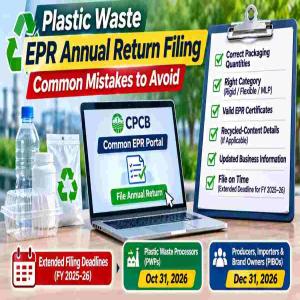
A business may complete its Extended Producer Responsibility (EPR) registration, arrange plastic waste recycling, and purchase the required certificates, yet still face compliance difficulties when filing its annual return.

Your Effluent Treatment Plant (ETP) may be running every day, with pumps operating, blowers functioning, and wastewater passing through each treatment stage.
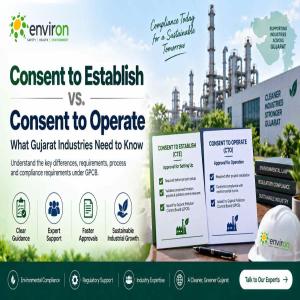
Confused about CTE and CTO from the Gujarat Pollution Control Board? Here is what each approval covers, when you need it, and how the two differ.